
What is Art deco? Art Deco is a movement in architecture, art and design that flourished in the 1920s and 1930s. Its designers used geometry to give ordinary objects a distinctly modern presence. Picture a small radio with a rounded wooden case, a row of narrow horizontal slots and a bright metal dial. Even with the sound switched off, those details give it a sense of speed. A skyscraper, an evening gown and a cinema ticket could express the same idea at entirely different scales.
What is Art deco named after?
The name comes from a Paris exhibition held in 1925, the Exposition internationale des arts décoratifs et industriels modernes. The last words of its French title capture an ambition that explains much of the style. Designers were interested in what industry made possible, even when the object on display required painstaking handwork. An intricate cabinet could celebrate a machine age through a surface polished smooth enough to catch a sharp reflection.
Another way to recognize the period is to compare two drawings of a flower. In an Art Nouveau design, the stem might wander across the page in a winding line. A Deco designer might simplify the petals into wedges and arrange them around a center. Both approaches start with the same flower, yet the first invites you to follow a gesture and the second to notice the symmetry.
Reading a building from the pavement
What is Art deco doing to the outline of a building? Look up at New York’s Empire State Building and follow the setbacks as its tower narrows. Then imagine drawing its silhouette with a thick pencil. You can leave out hundreds of windows and still convey the impression of a series of great steps climbing toward a point.
At the scale of a house, the same exercise helps separate construction choices from decorative ones. A contemporary LSF structure can carry an entrance canopy whose stepped outline recalls a cinema marquee. From the pavement, the rhythm of those edges gives the entrance its character. The steel framing behind them answers a different design question.
How to recognize the pattern
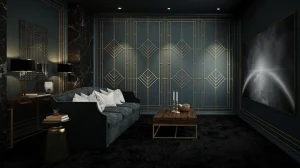
What is Art deco geometry like up close? Start with a fan. Several lines spread from a single point, each at a slightly different angle. Transfer that figure to the back of a chair and the narrow ribs draw the eye upward. Turn it upside down on a pendant shade and the same lines lead the eye toward the table.
An entrance hall in a Kit House offers a good place to experiment with scale. Cut the proposed outline of a fan mirror from paper and tape it above a console. Stand in the doorway. If the curved top almost grazes the ceiling, try a smaller version. The strip of plain wall around its edge is what lets the shape register from several steps away.
What is Art deco like on paper?
Fashion illustrator Erté offers a way into the style through drawing. Look at how the sweep of a garment can extend the line of a figure. A sleeve, a train or a strand of jewels gives the eye a route across the page. The figure remains legible even when parts of the costume approach pure pattern.
Try sketching a travel poster for a fictional seaside town. Use a circle for the sun, a diagonal for the beach and a dark upright for a diver. With those three forms in place, you can already tell where the light comes from and where the action will happen. The lettering can pick up the angle of the shore.
What is Art deco furniture like to live with?
Imagine a walnut sideboard with curved ends, dark handles and a pale stone top. Its long front gives the wood grain room to run, while the stone draws a clean horizontal line above it. In a compact kit home, check that the cabinet doors open comfortably and that someone can pass behind a dining chair. Furniture gets much of its presence from the space you can leave around it.
What is Art deco lighting meant to emphasize?
Picture a frosted globe beside a fluted wall. From the front, the ridges may look almost flat. Move the light to one side and a sequence of narrow shadows appears. For a renovation that includes construction consulting, bring a finish sample to the lighting discussion. Seeing the real shadow on a handspan of plaster makes it easier to decide where a fixture belongs.
What is Art deco color beyond black and gold?
Try petrol blue beside walnut, with a sliver of cream between them. From across the room, the cream line defines the cabinet edge. Up close, the grain supplies a second, finer pattern. A bright metal handle can finish the composition, but the relationship between the larger areas of color already gives the piece definition.
For a media room, a soundproof wall covering might be part of the finish schedule. Once you have selected a product for the room’s acoustic needs, lay out its seams alongside the screen and door frames. A repeated vertical joint can give a broad wall the measured rhythm of a theater interior.
What is Art deco influencing today?
Rise Art points to contemporary artists who borrow particular features of the movement. One example is sculptor Mark Beattie, whose metal loops incorporate light. Following a bright line as it circles an empty center is a different experience from looking at a solid ornament. The empty space becomes as interesting as the polished surface around it.
What is Art deco worth keeping in a modern interior?
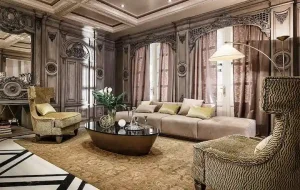
Choose the detail that first caught your eye. It might be the rising steps of a tower or the curve of an illustrated sleeve. Repeat that movement once, perhaps in a mirror over a desk or in the border of a rug. A room with one clearly expressed idea gives you something to see from the doorway and a reason to walk closer.